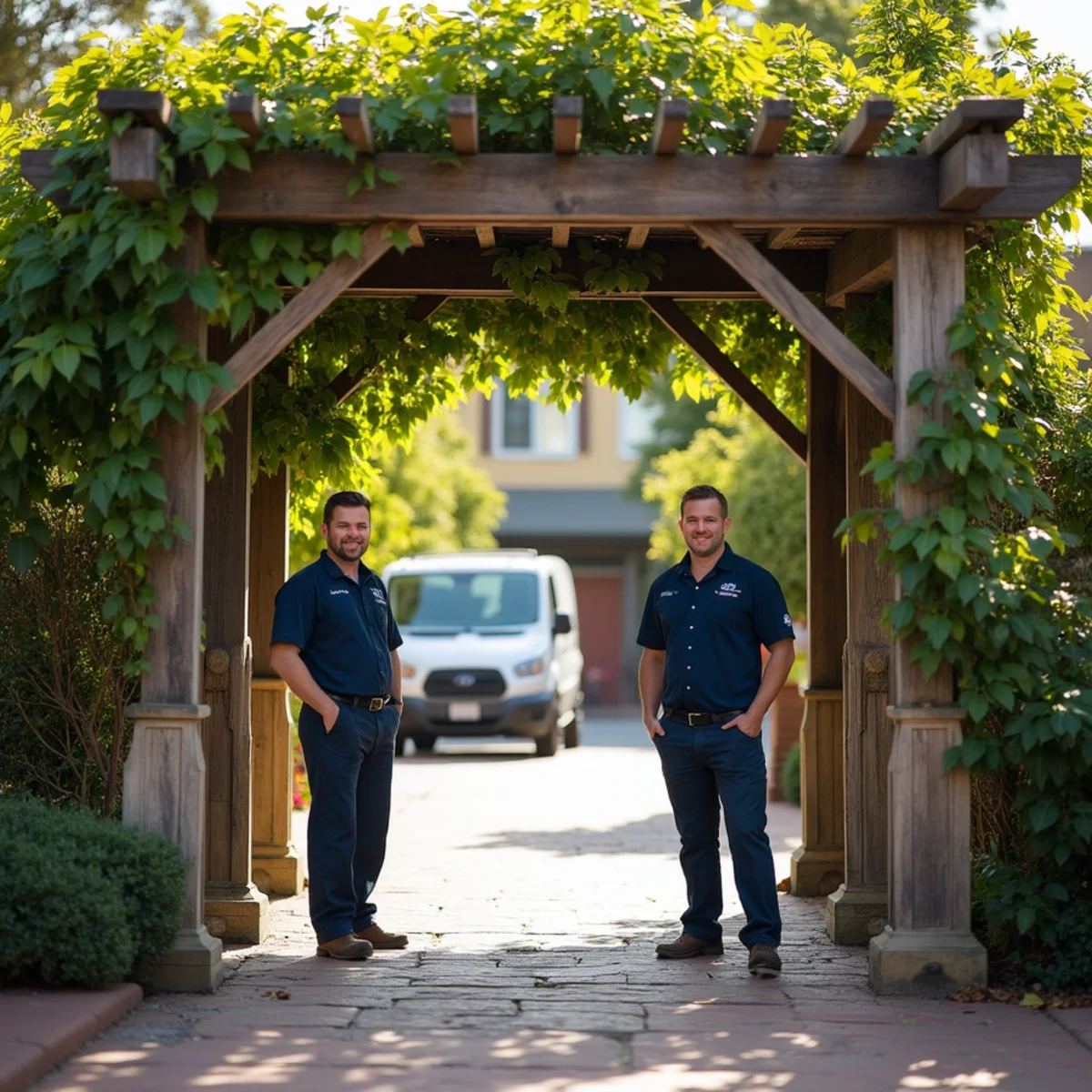
Stand in the middle of Todos Santos Plaza on a summer evening and you are standing on the reason Concord exists. The square was laid out in 1869 when merchants moved to this higher ground, and its historic pergola has anchored the plaza's concerts and farmers markets for generations. The plaza is beautifully kept. The buildings ringing it are another matter — a mix of eras, and many of them carrying decades-old plumbing behind their storefronts.
Downtown's charm is its age, and age is also its plumbing liability. This is a look at the aging building stock around Todos Santos Plaza, the specific ways water damage shows up in older commercial buildings, and why the businesses and property owners here benefit from moving fast when a pipe or a roof lets go.
A downtown built in layers
Concord's downtown did not appear all at once. It grew in layers around the 1869 plaza, with buildings added, altered, and rebuilt across a century and a half. The result is a streetscape where a modern restaurant can share a wall with a structure that has been standing, and plumbed, since long before anyone thought about modern codes.
That layered history is what makes downtown feel like a real place instead of a strip mall. It also means the plumbing and roofing behind those facades span every era, including plenty that is well past its intended service life. The pergola gets the restoration budget and the attention; the supply lines above a shop's drop ceiling do not.
How water damage behaves in old commercial buildings
Older downtown buildings share a set of vulnerabilities. Original galvanized supply lines corrode and leak. Flat and low-slope roofs common on commercial blocks pond water and find their weak seams during winter storms. Shared walls and party walls mean a leak in one tenant's space becomes the neighbor's problem. And drop ceilings and built-out interiors hide leaks until they have been running long enough to stain, sag, and drip into the retail space below.
The stakes are different than in a home, too. A commercial water loss can shut down a business, ruin inventory, and put employees out of work for the duration. Every hour the space is closed is revenue gone, which is why fast, correct water damage restoration in Concord matters even more for downtown tenants than the square footage alone would suggest.
- Original galvanized supply lines corroding behind finished walls
- Flat, low-slope roofs ponding water and failing at aged seams
- Shared and party walls carrying one tenant's leak into the next unit
- Drop ceilings and build-outs hiding leaks until they stain and drip
- After-hours failures that run for hours before anyone is on site
Winter storms and the downtown roofline
The rainy season is hard on old commercial roofs. The low-slope roofs typical of downtown buildings rely on membrane seams and drains that degrade with age and clog with debris. When December storms stack up, ponding water works through tired seams and around roof penetrations, then travels along the structure before it finally shows up as a stain on a tenant's ceiling — often far from the actual entry point.
Because the water travels, the visible damage rarely marks the source. Finding where it actually got in, and drying the concealed structure it passed through, is the difference between a real fix and a stain that comes back with the next storm.
Why the plaza's businesses cannot afford to wait
In a downtown built on foot traffic and street presence, a closed storefront is a problem beyond the water itself. Mold can begin within 24 to 48 hours, and in a shared building, moisture that is not dried properly migrates into neighboring units and common walls. What starts as one tenant's leak can become a whole building's remediation if it sits.
The businesses that recover fastest are the ones that treat a water loss as an emergency from minute one — shutting off the source, calling for extraction, and getting the structure dried and documented so the doors can reopen and the insurance claim holds up. Landlords and tenants both benefit from having that plan before the season, not during the leak.
Protecting Concord's historic heart
There is a preservation angle here too. The older buildings around Todos Santos Plaza are part of what makes downtown Concord worth visiting. Proper restoration dries and saves original material where it can, rather than gutting historic fabric that cannot be replaced. Fast response is as much about preserving the building as protecting the business inside it.
If you own or lease space downtown, the practical steps are the same ones that protect any aging building: know where your shutoffs are, keep the roof drains clear before winter, watch for the early stains that signal a slow leak, and have a restoration number ready. Our guidance for retail-space water damage response applies just as well to a storefront on the plaza as to a mall unit.
Read the lease and the policy before the pipe does
For a downtown tenant, two documents decide how a water loss actually plays out, and both are worth reading before a pipe forces the issue. The first is your lease. In an older shared building the split of responsibility is rarely obvious: the landlord typically owns the roof and structure, but the tenant often owns everything inboard of the walls — the tenant improvements, the finishes, the build-out. Know which side of that line your losses fall on, and confirm who is obligated to repair what, so a claim is not stalled by an argument while your doors stay closed.
The second is your insurance. A property policy rebuilds the space; business-interruption coverage replaces the revenue you lose while it is closed — and for a plaza storefront living on foot traffic, the closure is usually the bigger hit. Many small tenants carry the first and skip the second; do not. Two habits round it out: locate both the building master shutoff and your own unit shutoff now, because tenants often cannot find either in an emergency, and put leak sensors in back-of-house and utility spaces, since downtown failures tend to run all night after everyone has gone home. When one does, our commercial water damage restoration crews work to get you reopened fast.
Frequently asked questions
Water Concord
IICRC-certified water damage restoration, based in Concord and serving all of Contra Costa County. We answer 24/7 — if you’re dealing with water damage right now, call (201) 277-9344.