
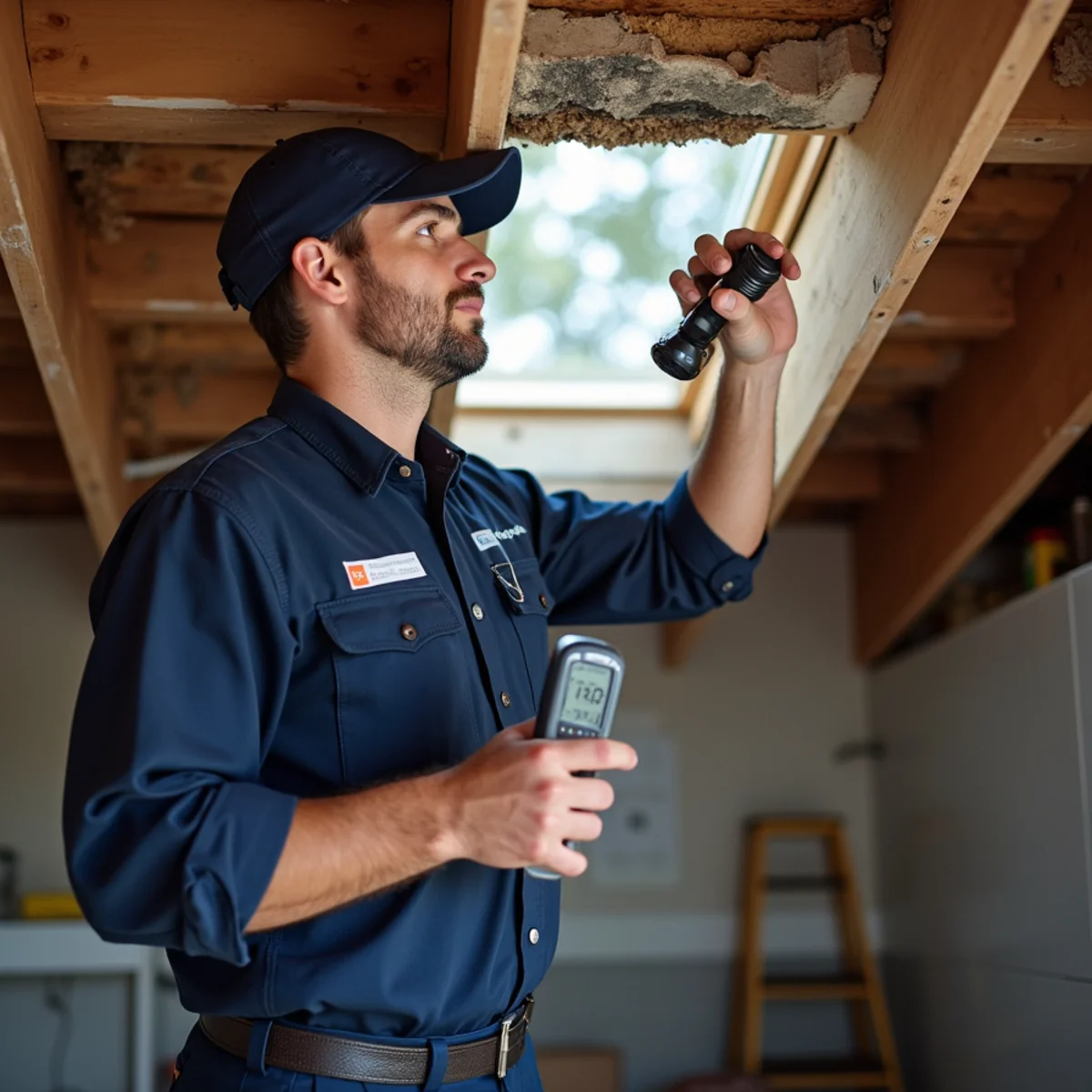
Roof leaks are deceptive because the damage inside rarely lines up with the hole outside. Water travels along rafters and truss chords, pools on the top of a ceiling, and soaks insulation before it finally stains the drywall and drips into the room. By then it has been wet in the attic for a while, and mold can start growing within 24 to 48 hours in that dark, unventilated space. A slow roof leak can rot sheathing and framing long before you ever see a stain.
Water Concord handles the interior side of a roof leak — the part that turns into water damage. We dry the attic, insulation, ceiling, and walls, treat for mold, and repair the ceiling and drywall damage. We will also help you get a tarp or temporary cover in place and coordinate the roof repair so the leak is stopped before we dry.

Signs a roof leak has caused interior water damage
Roof leaks show up inside, often far from the actual breach. Call us if you notice any of these:
- A brown or yellow ring on the ceiling that grows after each rain
- Active dripping from the ceiling or a light fixture during a storm
- Sagging or bulging drywall on the ceiling, a sign of pooled water above
- Damp, matted, or discolored attic insulation
- Water stains running down an interior or exterior wall from above
- Peeling paint or bubbling on the ceiling and upper walls
- A musty smell in the attic or upstairs rooms after wet weather
- Daylight visible through the roof boards, or damp, dark sheathing in the attic
Why the leak outside and the damage inside do not line up
Water is patient and it always runs downhill. When a roof leaks — a lifted shingle, a failed flashing around a vent, a cracked seal at the chimney — the water rarely drops straight down. It runs along the top of a rafter, travels to a low point, and soaks the ceiling drywall or runs down inside a wall cavity several feet away from the actual breach.
That is why chasing a roof leak by the location of the ceiling stain usually fails. We use moisture meters and thermal imaging to trace the water back to where it is actually entering and to map how far it has spread through the attic, insulation, and walls. Only then can we dry the whole affected area instead of the one spot you can see.
Our roof leak water damage process
Here is how a Water Concord roof leak cleanup runs, from the first call to the finished repair.
- Rapid dispatch. A local crew arrives with drying and moisture-mapping equipment, targeting inside 60 minutes.
- Stop the water. We help get a temporary tarp or cover over the breach and, if a ceiling is bulging with trapped water, relieve it safely to prevent a collapse.
- Moisture mapping. Meters and thermal imaging reveal how far the water traveled through the attic, insulation, ceiling, and walls.
- Extraction and structural drying. We remove saturated insulation as needed and set air movers and dehumidifiers, drying to daily verified readings.
- Mold treatment. We treat the attic and cavities to stop mold from taking hold in the damp framing.
- Repairs. We restore the ceiling, drywall, insulation, and paint so the finished room shows no sign of the leak.
East Bay winter storms and Concord's roofs
Concord gets most of its 18 to 22 inches of annual rain in a tight window from December through March, and increasingly it arrives in atmospheric-river storms that dump inches at a time and drive rain sideways with wind. That is exactly the kind of weather that finds a weak spot in a roof — an aging shingle, a dried-out flashing seal, a gutter that overflows and pushes water under the eave.
Older Concord roofs feel it most. A lot of the city's housing dates to the 1950s through 1970s, and a roof at or past its service life will leak under a hard, wind-driven rain even when it stays dry the rest of the year. When a storm gets in, we handle both the water damage and the related storm damage cleanup. Our winter storm prep checklist for East Bay homes covers how to get ahead of it.
We dry the inside and coordinate the roof repair
A roof leak is two problems — the hole in the roof and the water damage inside — and they need to be handled in the right order. The roof has to be stopped, at least temporarily, before drying the interior makes sense; otherwise the next storm undoes the work. We coordinate the roofing repair and focus on the interior restoration.
If the leak hit during a storm and you need to act before help arrives, our post on what to do when a ceiling leaks during a storm walks through the first thirty minutes. Once the water is stopped, we dry the structure and restore the damage — see our full water damage restoration service for how the whole process fits together.
Roof-leak prevention before the rainy season
The best roof leak is the one that never gets in, and in Concord the time to prevent one is the dry stretch from late summer through fall, before the December-through-March rains arrive. A roof that looks sound from the ground can still hide a lifted shingle, a cracked flashing seal, or a gutter packed with debris, waiting for the first atmospheric river to find it. An hour of attention in September saves a stained ceiling in January.
It is worth the effort because a roof leak rarely stays small. Water works into the sheathing and insulation and sits there through storm after storm, so by the time a stain reaches the ceiling the damage above it is usually weeks old. Our winter storm prep checklist for East Bay homes goes deeper, but a few checks catch most of what we later get called out for:
- Clear the gutters and downspouts so water drains instead of backing up under the eaves and shingles.
- Look for lifted, curled, or missing shingles, especially on the weather side that takes Concord's wind-driven rain.
- Inspect the flashing around vents, skylights, and the chimney, where dried-out seals are a common entry point.
- Trim back branches that overhang the roof and drop debris or scrape shingles in a storm.
- Check the attic on a bright day for daylight, damp sheathing, or stained framing that hints at an old, slow leak.
Standing water spreading?
Every hour the water sits, the damage grows. Talk to a Concord crew now.
What affects the cost of roof leak water damage restoration
We inspect before quoting — no honest estimate comes sight unseen. These factors move the cost:
- How long the roof leaked and how many storms it endured before repair
- How far the water spread through the attic, ceiling, and walls
- Whether insulation is saturated and must be removed and replaced
- The extent of ceiling and drywall damage and any sagging or collapse
- Whether mold has started in the attic or wall cavities
- The temporary roof protection needed until a permanent repair is made
Why Concord homeowners choose Water Concord for roof leak water damage restoration
When water is where it shouldn’t be, you need a crew that shows up fast and does it right. Here’s what you get with Water Concord:
60-minute emergency dispatch across Concord
We’re based in Concord, so roof leak water damage restoration starts before the damage has time to spread.
IICRC-certified technicians
Every job follows the IICRC S500 standard, with drying verified by moisture meters — not guesswork.
Licensed & insured
Fully licensed and insured, so your home and your project are protected from day one.
Insurance claim assistance
We document the loss, record moisture readings, and bill your carrier directly for covered work.
Locally owned & operated
You deal with a local team that answers for its work, not a national franchise queue.
Rated 4.9 from 127+ local reviews — and we answer open 24 hours — 7 days a week.