

Water does not wait for business hours, and neither does the damage. Every hour it stands, it wicks deeper into subfloor, drywall, and framing, and mold can begin growing within 24 to 48 hours. A loss you could have contained at midnight becomes a gut-and-rebuild by the weekend. Household fans and a shop-vac barely touch the water already soaked into your floors and walls.
Water Concord answers 24/7. We are a local, IICRC-certified crew that picks up the phone at any hour and targets arrival within 60 minutes anywhere in Concord. We pull the standing water out fast with truck-mounted and portable extractors, then set up drying so the damage stops spreading. Call (201) 277-9344 and we dispatch a crew immediately.
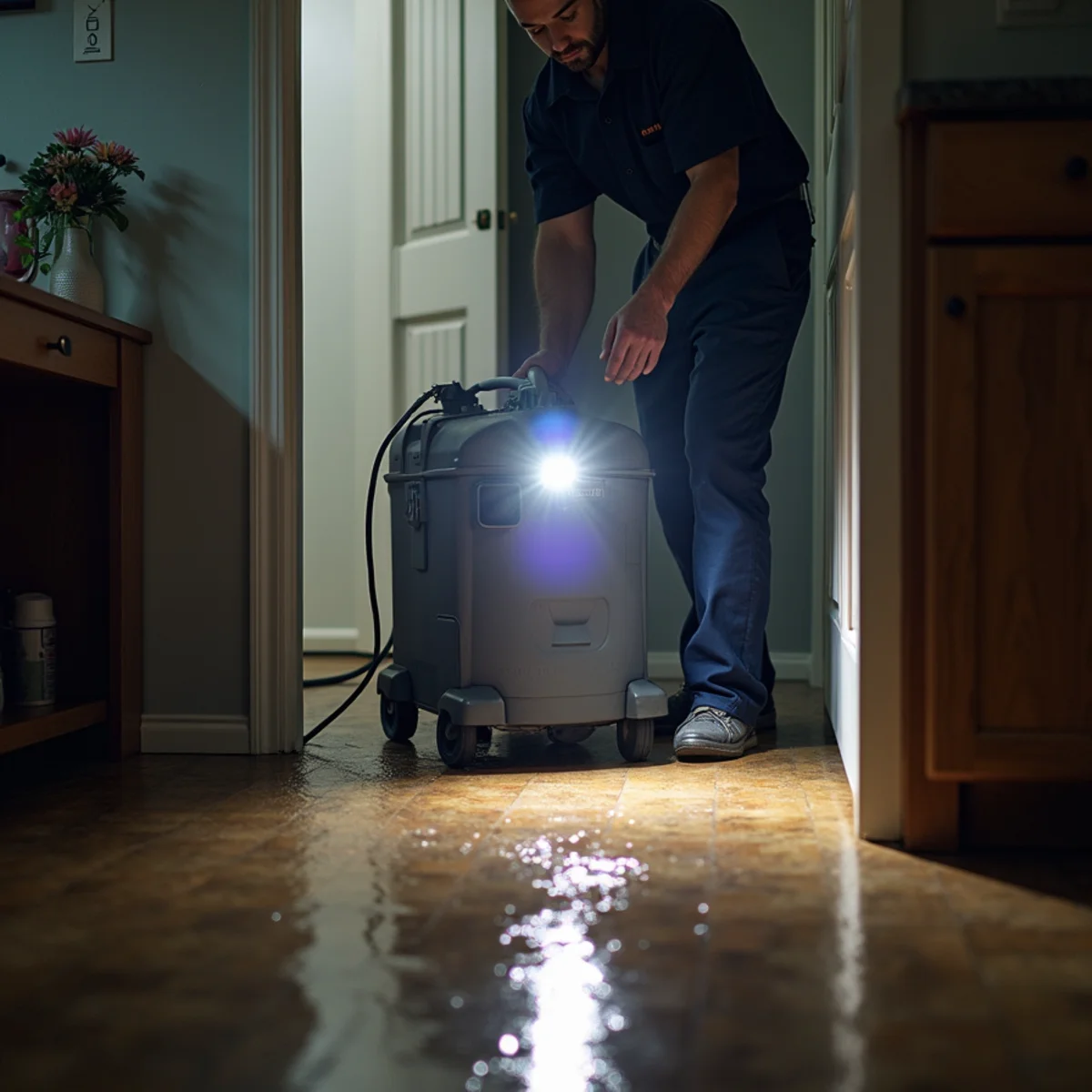
When to call for emergency water removal
Some water problems can wait for a scheduled appointment. These cannot. Call right away if you see any of the following:
- Standing water spreading across floors from a burst pipe, failed water heater, or overflowing appliance
- Water pouring or dripping through a ceiling or light fixture
- A supply line or hose that split and is still releasing water
- Water rising in a tub, sink, or toilet that will not drain
- Sewage or gray water backing up onto floors — a contamination emergency
- Water pooling near outlets, the electrical panel, or the furnace
- Soaked carpet and pad squishing underfoot across a whole room
- Any flooding you cannot stop by shutting off a single fixture
Why the first few hours decide everything
Water damage is a race against the clock, and it starts the instant the water is loose. In the first minutes it sits on the surface, where extraction is fast and clean. Within hours it soaks into carpet pad, wicks up drywall, and slips under tile. By the next day it is inside wall cavities and the subfloor, feeding mold and rotting framing.
That is why emergency response is not about panic — it is about staying ahead of the water. The sooner we extract the standing water and start drying, the less of your home the water touches. A fast midnight call routinely saves flooring and drywall that a wait-until-morning call would lose.
What happens when you call — our emergency response, step by step
Knowing the sequence takes some of the fear out of a 2 a.m. flood. Here is exactly how a Water Concord emergency call unfolds.
- We answer, 24/7. A real person picks up, asks where the water is coming from and which rooms are affected, and walks you through shutting off the water if it is still running.
- A local crew is dispatched immediately. We send the nearest Concord team and target your door within 60 minutes — no national call center, no waiting on a franchise van from another county.
- Safety and source check first. On arrival we confirm the scene is safe — power, gas, and contamination — and stop or confirm the water source before anything else.
- Standing water comes out. Truck-mounted and portable extractors remove water fast, then moisture meters and thermal imaging map the water you cannot see — behind walls, under floors, inside cavities.
- Drying equipment goes in. Commercial air movers and dehumidifiers are placed before we leave, so the structure begins drying the same night.
- Documentation for your claim. We photograph and log everything from the first minute, which is exactly what your insurer will ask for.
Emergency water removal across Concord, any hour
We live and work here, so an emergency call does not bounce to a distant dispatcher. Our crews know Concord — the post-war tracts off Monument Boulevard, the 1960s homes of Clayton Valley, the older housing in North Concord — and the plumbing that fails in each. That familiarity shaves minutes off every response, and in an emergency, minutes are flooring you keep.
We cover every Concord ZIP — 94518, 94519, 94520, 94521, and 94522 — and the surrounding Contra Costa County communities, day or night, holidays included. Whether the loss started as a hidden leak or a dramatic burst, standing water raises fair questions about whether it is safe to stay in the house — here is how to think that through while help is on the way.
Before we arrive: stay safe and slow the water
The most useful thing you can do in the first minutes is stop the flow. Close the fixture's shutoff valve, or if you cannot find the source, shut off the house at the main — here is how to find and shut off your main water valve before you ever need it.
Then stay clear of standing water near outlets or the panel, do not use a household vacuum on water, and lift what you can to a dry room. Leave the heavy extraction to us — we will be there shortly.
What water removal can save — and what usually has to go
The reason we push so hard on speed is that salvage is almost entirely a function of time. Water does not ruin most of a home on contact — it is the hours of soaking that do the real harm. Pull the water out quickly and dry what is left, and a surprising amount comes through intact: solid hardwood, tile, structural framing, and most sealed contents can often be saved when we reach them early. The faster we extract and begin structural drying, the more of your home stays yours.
We make these calls on site, from moisture readings rather than guesses, and we tell you honestly what is worth drying and what is cheaper to replace. Where something carries sentimental value, we will try to save it even when the odds are long — what we will not do is leave wet material in place to rot behind a wall, the false economy that turns a contained loss into a full rebuild. The sooner extraction starts, the shorter the list of losses gets. As a rough guide, here is what tends to survive an early response and what usually does not:
- Often saved: solid hardwood if dried fast, tile and stone, structural framing, metal, glass, and hard-surface furniture
- Sometimes saved: drywall caught before it swells, cabinetry, and books or documents if handled within the first day or two
- Usually lost: carpet pad, drywall that has wicked water high up a wall, particleboard and laminate, and soaked mattresses or upholstery
- Always discarded: anything touched by sewage or contaminated water that cannot be safely sanitized
Standing water spreading?
Every hour the water sits, the damage grows. Talk to a Concord crew now.
What affects the cost of emergency water removal
We do not quote emergency work sight unseen — the price depends on what the water did, and we write the estimate on site. These are the factors that move it:
- How much water is standing and how many rooms it reached
- The water category — clean supply water, gray water, or contaminated Category 3
- How long the water sat before extraction began
- The materials it soaked: carpet and pad, hardwood, tile, drywall, cabinetry
- Access to the water — an open floor is faster than water trapped under built-ins or in a crawl space
- How much drying equipment the space needs and for how many days
Why Concord homeowners choose Water Concord for 24/7 emergency water removal
When water is where it shouldn’t be, you need a crew that shows up fast and does it right. Here’s what you get with Water Concord:
60-minute emergency dispatch across Concord
We’re based in Concord, so 24/7 emergency water removal starts before the damage has time to spread.
IICRC-certified technicians
Every job follows the IICRC S500 standard, with drying verified by moisture meters — not guesswork.
Licensed & insured
Fully licensed and insured, so your home and your project are protected from day one.
Insurance claim assistance
We document the loss, record moisture readings, and bill your carrier directly for covered work.
Locally owned & operated
You deal with a local team that answers for its work, not a national franchise queue.
Rated 4.9 from 127+ local reviews — and we answer open 24 hours — 7 days a week.