Your carpet squished underfoot this morning, so you did the sensible thing and dragged out the wet/dry shop vac. An hour later the surface feels drier, the tank is full, and you figure the worst is behind you. It isn't. The water you can feel is a small fraction of what a flooded carpet actually holds, and the rest is sitting exactly where you can't reach it.
A shop vac empties the top layer and leaves the pad, the tack strip, and the subfloor soaked. That trapped moisture is where mold, delamination, and rot begin — often within a day or two. This is the difference between drying a carpet and drying the whole assembly underneath it. Here is what professional water extraction removes that a rented vac never will, and why it matters for homes in Dana Estates, Concord.
A flooded carpet is three layers, not one
When water spreads across a carpeted room, it does not just wet the fibers you walk on. It drains straight down through the carpet into the pad, then pools against the subfloor and wicks outward under the baseboards. What looks like one wet surface is really three saturated layers, and each one holds and releases water at a different rate.
A shop vac pulls from the top. It can lift standing water and some of the moisture in the face fiber, but it has almost no effect on the layers below.
- The carpet face — the fibers you see; dries fastest and fools you into thinking the job is done.
- The pad — a dense foam or rebond sponge that soaks up and holds many times its own weight in water.
- The subfloor — plywood, OSB, or a concrete slab that stays wet long after the surface feels dry.
What a shop vac physically can't do
A wet/dry vac is a genuinely useful tool for a spilled bucket. It is the wrong tool for a flood. The motor is small, the airflow is modest, and the tank fills in minutes, so most of your effort goes into trips to the driveway to dump it. More to the point, a shop vac has no way to compress the carpet and pad to force water back up out of them.
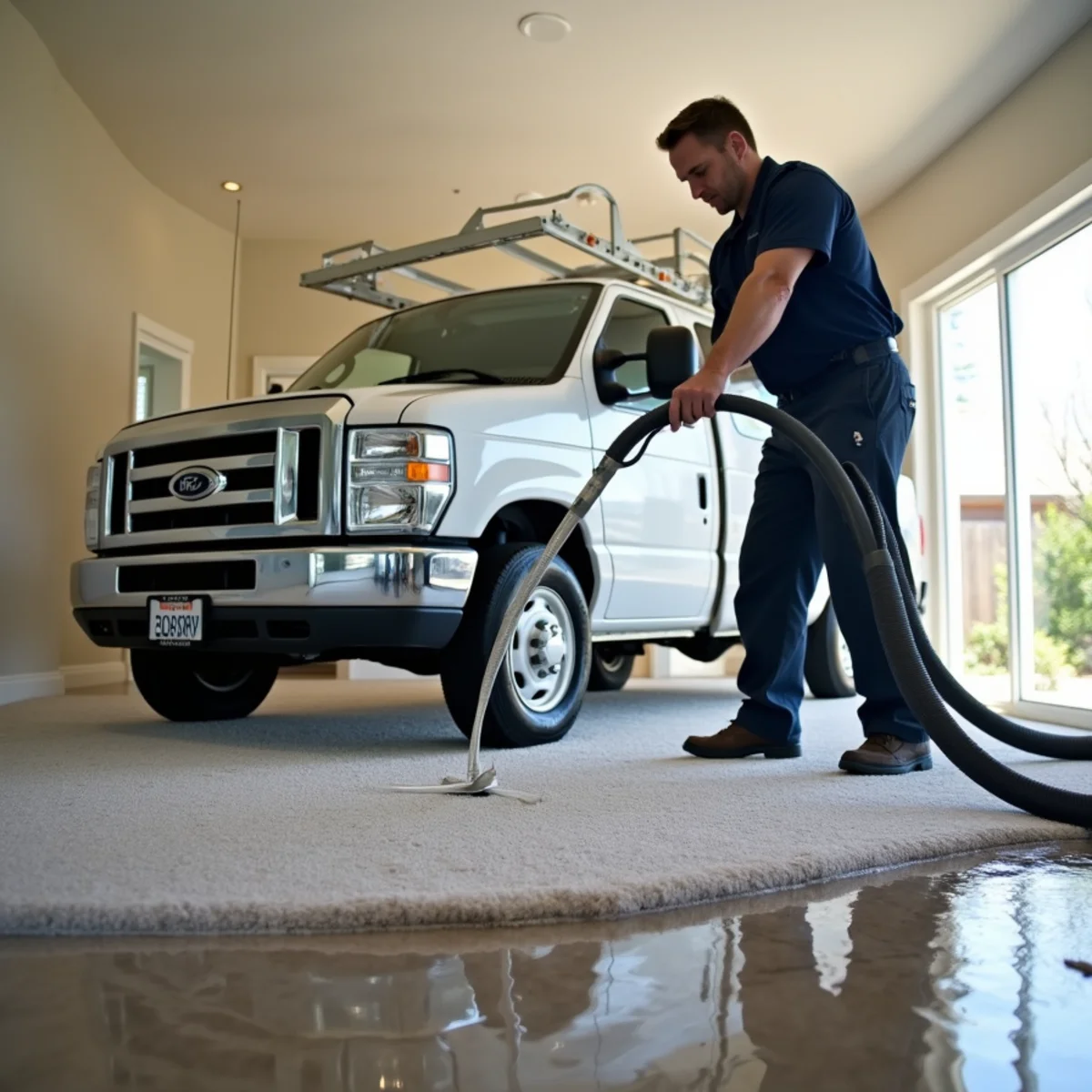
Professional extraction works on a different principle. A truck-mounted vacuum generates far more lift than any portable unit, and weighted extraction tools use the technician's own body weight to press water out of the pad and into the vacuum path. That combination pulls out gallons a shop vac would leave behind.
What professional extraction actually removes
When a crew extracts a flooded room properly, they are chasing water through all three layers, not skimming the top. A typical sequence looks like this:
- Standing and surface water, lifted first so the room is safe to work in.
- Water held in the pad, drawn up with a weighted extractor that squeezes each section of carpet.
- Moisture in the subfloor, confirmed with a meter and dried with targeted airflow once the bulk water is gone.
- Hidden migration, traced under baseboards and into wall cavities with a moisture map so nothing wet gets sealed up and forgotten.
Why the pad and subfloor decide everything
The pad is the part that ruins carpets. Once saturated, it stays wet for days and turns into a mold nursery — spores can take hold in 24 to 48 hours in a warm, damp pad. If the water was clean and you extract quickly, the pad can sometimes be floated and dried in place. If it sat too long or the water was contaminated, the pad comes out and gets replaced, which is far cheaper than replacing the whole floor later.
The subfloor is the part that warps. Plywood and OSB swell and delaminate when they stay wet, and a slab holds moisture that keeps re-wetting everything above it. Getting these dry — and confirming it with meter readings rather than a hand on the carpet — is the entire point of extraction.
The Dana Estates slab-on-grade angle
Many homes in Dana Estates, Concord sit on concrete slabs rather than raised foundations, and that changes how a carpet flood behaves. Water cannot drain into a crawlspace, so it spreads sideways across the slab under the carpet and pad, often reaching well past the visible wet patch. We routinely find moisture three or four feet beyond where the homeowner thought the water stopped.
On slab homes, fast and thorough water extraction followed by real structural drying is the difference between saving the carpet and tearing out flooring across half a room. A shop vac simply cannot see or reach that spread.
Pro insight: check the backing before you fight for the carpet
The question we get asked most is whether the carpet itself can be saved, and the answer usually comes down to one thing a shop vac can never tell you: whether the backing has delaminated. Carpet is a face yarn bonded to a primary backing, with a secondary backing glued on using latex. When that latex sits saturated too long, the two backings separate — delamination — and once they do, the carpet ripples and will not lie flat again no matter how well it dries.
Here is what we actually do on site. After extraction we lift a corner and flex the backing. If it feels crisp and bonded, the carpet is a real candidate for floating and drying. If it feels spongy, or the layers slide against each other, it is finished, and the honest call is to replace it rather than spend three days drying something that will bubble by summer.
Older carpet with a worn, brittle backing delaminates faster, so age matters as much as water exposure. When the carpet is worth saving, prompt structural drying of the pad and subfloor beneath it is what protects that latex bond while everything comes back to dry.
Frequently asked questions
Related pages
Water Concord
IICRC-certified water damage restoration, based in Concord and serving all of Contra Costa County. We answer 24/7 — if you’re dealing with water damage right now, call (201) 277-9344.